

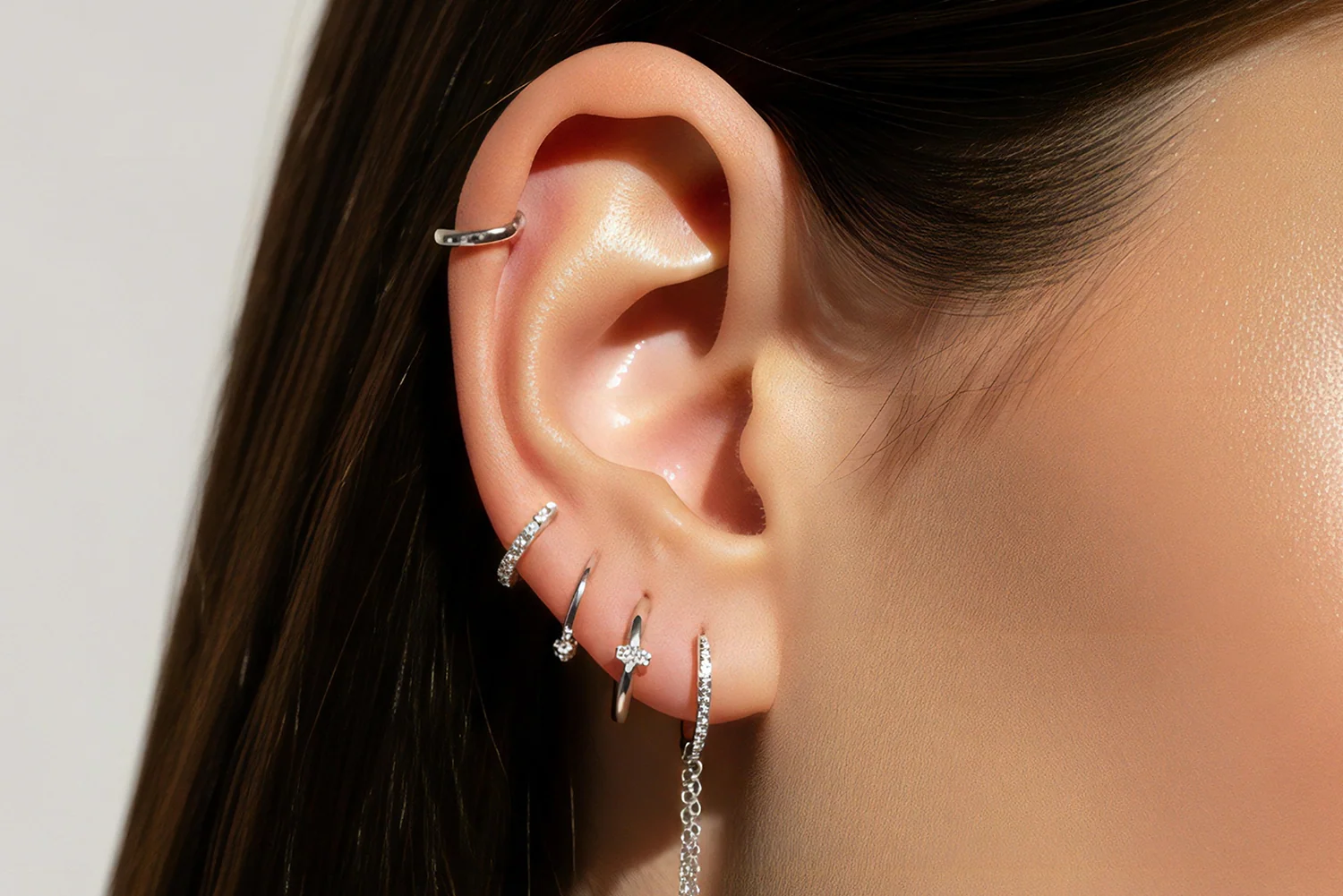
Quiet luxury in 2026 isn’t loud: it’s the fine gold jewelry you forgot you were wearing. So here’s what no one glamorizes about ear piercing healing: it takes longer than most people assume, and gets confusing fast when a lobe, helix, and conch are all on the agenda, and every gold cartilage earring has its own timeline.
Ear Piercing Healing: The Quick Answer
How long does an ear piercing take to heal?
Lobes heal fastest: think 6 to 8 weeks for initial healing. Cartilage piercings (helix, tragus, conch, daith) take significantly longer: 6 to 12 months, sometimes more.
Two things to know. Initial healing means the outside looks fine. Full healing happens deep inside the channel. One takes weeks. The other takes seasons.
The Complete Healing Time Chart by Piercing Type
What is the healing time for different ear piercings?
Ear piercings fall into two healing camps: soft tissue (lobes, upper lobes, transverse lobes) and cartilage (every other placement). Soft tissue piercings heal in 6–10 weeks initially; cartilage needs 3–9 months minimum with full maturation stretching past a year. The chart below breaks down 14 piercing types across both camps.
Healing Time by Piercing Type
| Piercing | Type | Initial Healing | Full Healing |
| Lobe | Soft tissue | 6–8 weeks | 4–6 months |
| Upper Lobe | Soft tissue | 8–10 weeks | 4–6 months |
| Transverse Lobe | Soft tissue | 2–3 months | 6–9 months |
| Helix | Cartilage | 3–6 months | 9–12 months |
| Forward Helix | Cartilage | 3–6 months | 9–12 months |
| Tragus | Cartilage | 3–6 months | 6–12 months |
| Conch (Inner/Outer) | Cartilage | 6–9 months | 9–12+ months |
| Daith | Cartilage | 6–9 months | 9–12 months |
| Rook | Cartilage | 6–9 months | 9–12 months |
| Snug | Cartilage | 6–9 months | 12+ months |
| Industrial | Cartilage | 6–9 months | 9–12+ months |
| Flat | Cartilage | 6–9 months | 9–12 months |
| Anti-Tragus | Cartilage | 6–9 months | 9–12 months |
| Orbital | Cartilage | 6–9 months | 12+ months |
Soft Tissue vs Cartilage: Why Healing Time Varies
Soft tissue (lobes) gets rich blood flow. It heals faster. Cartilage is different: less blood supply, slower cell turnover, longer everything. That’s not a flaw. It’s biology working carefully.
Healing Stages Explained (What Happens Over Time)
Healing moves through four stages: inflammation (week 1), early healing (weeks 2–4), surface healing (weeks 5–8), and internal maturation (months 3–12+). Each stage looks and feels different, and the outside healing well before the inside is the trap most people fall into.
Stage 1: Inflammation (Week 1)
Tender. A little swollen. Slight redness. Your body doing exactly what it should.
Stage 2: Early Healing (Weeks 2–4)
Swelling fades. You might see clear or pale crust (lymph). Normal. Clean gently and resist the urge to twist.
Stage 3: Surface Healing (Weeks 5–8)
The outside looks healed. The inside isn’t. This is the trap most people fall into. Keep the jewelry in. Keep the routine going.
Stage 4: Internal Healing & Maturation (Months 3–12+)
The channel strengthens and stabilizes from the inside out. This is where cartilage especially needs your patience.
What’s Normal During Healing (And What’s Not)
Mild swelling, faint redness, clear or pale crust, and some tenderness are normal during healing. Persistent heat, spreading redness, thick yellow or green discharge, or increasing (not decreasing) discomfort are the signs a piercing needs attention.
Normal Signs
Mild swelling, slight redness, clear or white-ish crust, some tenderness. All expected guests.
When a Piercing Needs Attention
Heat that lingers. Swelling that keeps growing past week two. Yellow or green discharge. Increasing discomfort instead of decreasing.
Irritation vs Infection (Quick Comparison)
| Irritation | Infection |
| Pink, localized | Red, spreading |
| Mild tenderness | Throbbing discomfort |
| Clear fluid | Thick discharge |
| Improves with rest | Worsens over time |
How to Clean Your Piercing Properly
What is the best way to clean a new ear piercing?
The best way to clean a new ear piercing is twice-daily sterile saline applied with a clean cotton pad or Q-tip, and nothing more. Skip alcohol, peroxide, and antibacterial soap. Avoid twisting the jewelry. The cleaning routine below takes under a minute.
Step-by-Step Cleaning Routine
- Wash your hands. Always.
- Saturate a clean cotton pad or Q-tip with sterile saline.
- Gently press around (not into) the piercing.
- Let it air-dry. Don’t towel it.
- Twice daily. That’s it.
What NOT to Use (Myths vs Reality)
- Rubbing alcohol: dries and damages new tissue.
- Hydrogen peroxide: kills the very cells you’re trying to build.
- Antibacterial soap: too harsh for fresh piercings.
- Twisting the jewelry: re-opens the wound every single time.
Less is genuinely more here.
Aftercare Do’s and Don’ts
Good aftercare is consistent and gentle, not aggressive. The Do’s cover clean hands, clean pillowcases, and leaving jewelry in. The Don’ts cover touching, twisting, and early swaps.
Do’s
- Clean twice daily with sterile saline.
- Swap pillowcases every 2–3 nights.
- Leave starter jewelry in for the full recommended window.
Don’ts
- Touch with unwashed hands.
- Sleep face-down on fresh cartilage.
- Change jewelry early “just to see.”
Lifestyle Factors That Affect Healing
Four everyday variables affect how smoothly a piercing heals: sleeping position and pillow hygiene, pressure from headphones, helmets, or glasses, sweat and humidity exposure, and contact with hair products or pollution.
Sleeping Position & Pillow Hygiene
A clean pillowcase is the cheapest healing tool you own. A travel pillow (doughnut-style) keeps pressure off fresh cartilage on side-sleep nights.
Headphones, Helmets & Glasses
Over-ear anything presses exactly where healing is happening. Switch to earbuds temporarily, or space out wear time.
Sweat, Gym & Humidity
Rinse with saline post-workout. Don’t let sweat sit.
Hair Oils, Shampoo & Pollution Exposure
Tilt your head away from fresh piercings when you wash. City air? Add a rinse to your evening routine.
Why Your Jewelry Choice Matters
This is where most aftercare guides stop short. Three jewelry factors shape a healing piercing more than any aftercare product: material integrity (solid gold vs plated), backing design (flat back vs butterfly), and insertion mechanics (internally threaded vs not). We go through each below.
Solid 14K Gold vs Plated Metals
Plated jewelry has a coating. Coatings flake. Flakes sit in a fresh piercing. Solid 14K gold has nothing to shed: never plated, never filled, same material all the way through. Alloy it nickel-free, and there’s nothing in the metal working against your healing either. Just gold doing what gold does.
Flat Back Earrings: Designed for All-Day Comfort
A flat disc sits flush against the back of your ear. No butterfly back pressing into the pillow at 2 a.m. Low-profile. Sleep-friendly. Pressure-free. Our flat back gold stud earrings aren’t “switch to after healing” jewelry; they’re designed to heal with from day one. Solid 14K gold, nickel-free, built to be lived in.
Quick fit tip: size up slightly for fresh piercings to give swelling room; size down once fully healed for a snug, flush sit.
Internally Threaded Flat Backs: How They Work
Here’s the clever part. The flat back is the piece sized to your piercing: you choose your post length, and that’s the component built to fit. It goes in first, from behind the ear, disc flush, its smooth solid gold post sliding through. The threading sits hidden inside the back, so nothing threaded ever touches your piercing. Then you thread the decorative front into the back until it stops.
Every few days, hold the front steady with one hand and give the back a gentle turn with the other. Two seconds. That small ritual is what keeps them where you put them for years.
When Can You Change Your Earrings?
Lobes can be safely changed after 6–8 weeks of consistent healing; most cartilage piercings need 3–6 months or longer before any swap. The safest signal is the piercing itself: no tenderness, no discharge, no stickiness when the jewelry moves.
Safe Timelines by Piercing Type
Lobes: after 6–8 weeks, ideally longer. Cartilage: wait the full recommended window. Any gold cartilage earring — whether helix, conch, or tragus — should stay in a minimum of 3–6 months before any swap.
Signs You’re Ready (Checklist)
- No tenderness when touched
- No discharge for 2+ weeks
- No redness or swelling
- The jewelry moves freely without sticking
How to Support Smooth Healing
Consistency beats intensity. Clean gently. Avoid pressure. Let good jewelry do its job.
The biggest things that slow healing? Over-cleaning, low-quality metals, and early jewelry swaps.
Quick Self-Check: Is Your Piercing Healing Properly?
How do I know if my piercing is healing properly?
A piercing is healing properly when discomfort decreases week over week, swelling resolves by the end of week two, any discharge stays clear or pale, and the jewelry moves freely without sticking. Use the self-check below: four or more boxes ticked means you’re on track.
- [ ] No increasing discomfort
- [ ] No spreading redness or heat
- [ ] Discharge (if any) is clear or pale
- [ ] No persistent swelling past week two
- [ ] Jewelry moves freely, doesn’t stick
When to See a Professional Piercer
If something feels off, go. A professional piercer can assess the piercing, check jewelry fit, and tell you whether what you’re seeing is irritation, pressure from the wrong backing, or something that needs more care. They’re the right first call.
FAQs
Can I shower with a new ear piercing? Running water is fine. Let it rinse over the piercing rather than aiming shampoo or soap directly at it, and follow with a saline rinse. For pools and hot tubs, wait a few months: the concern is the open channel in stagnant water, not the jewelry. Our flat backs handle water just fine.
Can I sleep in my earrings? If they’re flat backs, yes, and that’s the point. The flush disc sits low against your ear without poking the pillow. There’s a reason some people call them nap earrings. Still, avoid sleeping directly on a fresh cartilage piercing for the first few months regardless of backing style.
Why is my piercing still swollen? Swelling past week two could mean pressure from sleeping on it, reaction to low-quality metal, or over-aggressive cleaning. Check your sleep setup, check your material, scale back to plain saline twice daily, and give it a few days.
Can I change earrings early? Technically you can. Should you? No. Changing too early disrupts the channel, introduces new material before healing completes, and often restarts the clock entirely. Wait for the full window.
